

From Observation to Engagement: what it means to be part of something bigger
24th September 2026
Written by Sarah McAllister, Head of Improvement Programmes
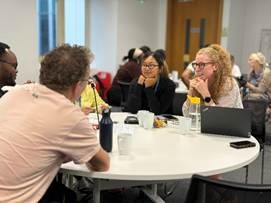
Since we last wrote about the Observation to Engagement programme, a lot has changed. Phase Two is drawing to a close, 20 more wards are preparing to join us in Phase Three, and the message that brought us together at Alie Street — that this is a programme about humanity, not observations — is proving true on ward after ward.
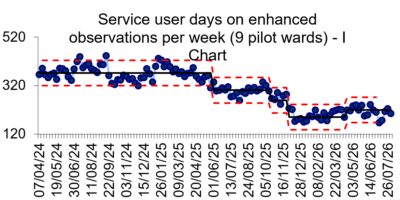
It began in April 2025 with 9 pilot wards testing a simple idea: that observation levels can come down safely when they’re backed by real engagement, structured review and strong multidisciplinary decision-making. Eighteen months on, that idea has spread to 21 wards in Phase Two and is about to reach every remaining inpatient ward in the Trust.
The numbers tell part of the story. Our original 9 pilot wards have sustained a 41% reduction in enhanced observations. The 21 Phase Two wards have gone further still, now averaging a 56% reduction. By contrast, the 20 wards due to join us in Phase Three show observations at the same level as baseline, measured before any formal programme support began. It’s a useful comparison: it tells us that what we’re seeing on Phase One and Two wards isn’t background noise or a Trust-wide trend that would have happened anyway. It’s the result of teams testing ideas, reviewing daily, and choosing to do things differently — with the individual ward stories behind those numbers told within this newsletter.
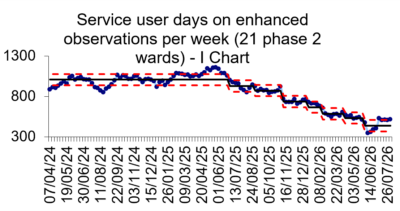
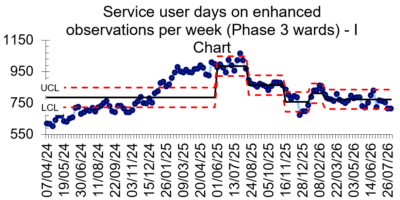
What we want to reflect on here is something a little different: not what any one ward has done, but what it’s actually like to be part of a programme like this — one running across 55 wards, three phases and eighteen months — and why that scale seems to matter as much as any single change idea.
Talk to staff who’ve been part of Observation to Engagement, it’s clear what the work means to them. As one colleague put it:
“I think it is always really nice, particularly when the junior nursing staff get an opportunity to get out of the ward and network with people from other
 directorates. I think it's a good opportunity for people. I think they enjoy it.”
It’s not just about being somewhere else for an afternoon. It’s about what staff bring back with them:
“I think they get to see work which is happening elsewhere. So they do pick up ideas that they can try and implement maybe if they think they will.
And it also gives them a chance to show off a bit. And I think that's nice for the staff when they can, sort
of show off what they are doing and what they have achieved.”
That exchange runs both ways — teams don’t just show what they’ve done, they leave with things they didn’t have before. One team described discovering the Relational Early Warning Score tool this way:
“I can honestly say we are really interested in the relational early warning scores thing. And without having gone to that workshop, we
wouldn't have known about it. So I think it is useful like that.”
And for staff working on wards that can be relentless, there’s something else a large-scale programme offers that’s easy to overlook… space to think.
“The wards can be so hectic, any opportunity to get out and just have a proper bit of headspace to think about something is a good thing.
And it just reminds people that you are part of your team, but you are part of a much larger team as well. And I think it's nice for the
staff to realise that and appreciate the trust that they do work in, where there's a lot of good work going on.”
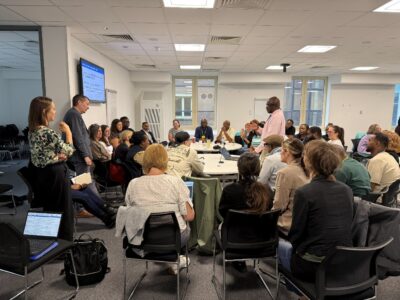
Reading those reflections together, a case starts to build for why this work has been run as a large-scale programme rather than a series of separate, ward-led projects. A single ward testing a change idea has to find its own motivation, its own evidence that the idea is worth trying, and its own confidence that it is safe to keep going when observation levels drop. Being part of something bigger means teams can draw on the experience of others: the reassurance of data on a chart showing dozens of other wards on the same journey, a shared language and shared tools so nobody is starting from a blank page, and a room full of other teams who have felt the same nervousness and can say honestly what helped.
Bringing teams together in this way creates the conditions for people to learn from one another, build confidence and keep moving at pace. It means individual teams can spend their energy on the relationships in front of them, supported by the evidence, experience and encouragement of the wider programme, rather than having to work out alone whether the approach is worth the risk.
It also, quietly, does something for morale. Ward work rarely comes with much occasion to step back and see the shape of what you’re contributing to. A learning session, a workshop, a chance to compare notes with a ward two boroughs away — these are small things, but they add up to staff feeling part of a Trust that is genuinely trying to do better by the people it cares for, together, rather than ward by ward in isolation.
Phase Three teams have now been onboarded, ahead of our official launch on 8 September 2026. From that date, the CARE that Counts bundle will spread to the remaining 20 wards across the Trust, supported by the Improvement Leaders’ Programme. Alongside this, we’re working with Phase One and Two teams to embed the improvements already made into business as usual, with a focus on quality control, monitoring and continuous improvement to ensure they are sustained over time.
The programme is expected to close in March 2027, and by then every inpatient ward in the Trust will have had the chance to test this way of working — and to be part of the wider team that makes it possible. What is most striking, looking back, is that the individual ward stories and the programme-wide story are really the same story, told at two different scales. It was never really about observations. It is about the connections that help people feel safe, seen and understood — between staff and the people they care for, and just as importantly, between wards, boroughs and directorates, making it possible to do this work together rather than alone.
Most Read Stories
-
Why is Quality Control important?
18th July 2018
-
2016 QI Conference Poster Presentations
22nd March 2016
-
Recognising Racism: Using QI to Help Take Action
21st January 2021
-
QI Essentials: What does a Chief Quality Officer do?
18th March 2019
-
-
Using data enabled us to understand our problem
31st March 2023
Follow QI on social media
To keep up to date on the latest concerning QI at ELFT, follow us on our socials.