

In Their Own Words: What 27 Service Users Told Us
24th September 2026

 By Melissa Dantes (Peer Tutor & QI Senior Sponsor) and Sarah McAllister (Head of Improvement Programmes)
The Observation to Engagement programme has always been built on a simple belief: that reducing intermittent observations only works, and only feels safe, if it’s replaced by something real — engagement that helps people feel seen, heard and supported. We can measure the observation reductions on an I-chart. What’s harder to capture is whether that belief is actually true for the people on our wards. So this summer, one of our Expert by Experience senior sponsors, Melissa Dantes, went out to find out.
So far, Melissa has spoken to 27 service users across six wards — City & Hackney, Tower Hamlets and Newham among them — asking three simple questions, each on a scale of 1 to 7: how satisfied are you with the care you’ve received, how satisfied are you with recovery-focused engagement — time with staff, meaningful activity — and how safe do you feel. And for anyone who scored low, a follow-up: what would a 7 look like?
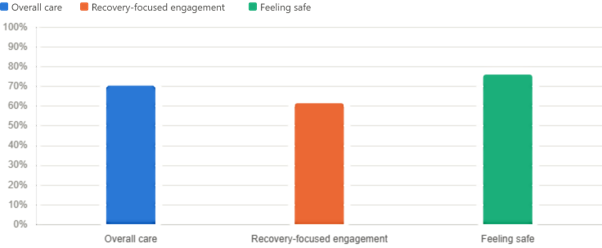
Figure 1 – service user experience on our inpatient wards
70.4% of respondents rated their overall care positively, and 76% told us they feel safe on the ward. This is encouraging, as it shows us that service users are feeling safe and cared for, whilst also being able to reduce observations. But the number that matters most for where we go next is the middle one. Satisfaction with recovery-focused engagement came in at 61.5% — noticeably lower than the other two. It’s still more positive than negative, but it’s the clearest gap in the picture, and it’s exactly the gap this programme was set up to close.
The comments explain why. Asked what a 7 would look like, people didn’t describe fewer checks or less supervision. They described more contact, more purpose, more involvement:
“More activities in groups. For staff to engage with patients whilst doing activities, not only playing music.”

“I would like more opportunity to speak with my doctor regularly, the same as I am able to speak to staff on the ward.”

“More interactions with clinicians.”
Others were clear that they already had that, and valued it enormously:
“Every member of staff has treated me very well and I would give them 10 out of 10.”

“I like to play a lot of sports like cricket and badminton; I have made friends on the ward.”
On safety, a similar pattern showed up. Most people feel safe, but felt safety turned out to be less about the physical environment and more about atmosphere — whether staff were visibly present, whether conflict was picked up on early:
“Sometimes there are not any staff in the main office and arguments break out, so I would feel safe if at least 1 staff member is in the office at all times.”

“It depends — sometimes I can feel really safe and other times not so safe. When there are lots of patients, some may get aggressive.”
And a recurring theme that cut across all three questions: people wanted to be listened to and involved, not just cared for.
“If they listen first instead of going for extra measures such as seclusion.”

“Medication should be discussed with patients and I should have a say about the medication I receive.”
None of this is a surprise, it’s the kind of thing staff on the ground already sense. But hearing it directly, at this scale, and being able to put numbers next to it, changes what we can do with it.
It’s also given real clarity to a gap we’d already started to notice in our own data. The CARE that Counts bundle — the four change concepts wards test as part of this programme — covers Confidence Building, Anticipating Needs, Relationships & Engagement, and Every Individual. Looking at what teams have tested so far, Anticipating Needs and Relationships & Engagement — things like MDT huddles and engagement hours — are well established. Confidence Building and Every Individual, which are much more about personalised, one-to-one, “what matters to you specifically” work, are the least tested of the four.
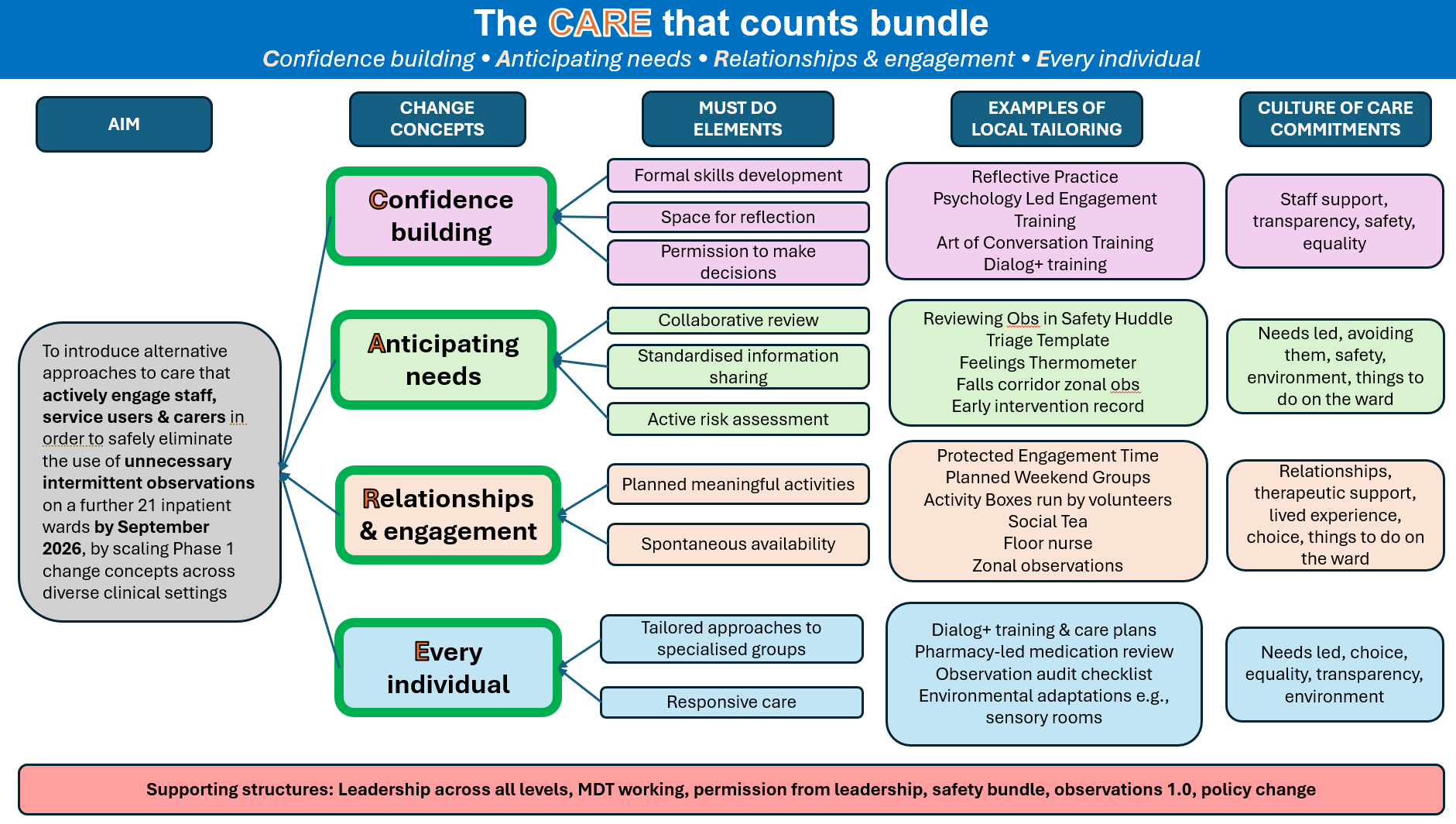
Figure 2 – the CARE that counts bundle
The service user feedback confirms that gap in people’s own words. Wanting more 1:1 time, more say over medication and leave, more reassurance on admission, more account taken of individual needs like language, privacy or trauma history — all of it points the same way. So as Phase Three gets underway, that’s where we’re putting deliberate weight: Dialog+ training and care plans, and the templates already in use for observation decisions, aimed specifically at strengthening Confidence Building and Every Individual, so all four concepts are felt evenly rather than the two that have come easiest so far.
We’ve shared these results with every team and directorate involved in the programme, not as a report to file away but as something to work with directly. Teams are being asked to bring the comments into their weekly huddles and ask themselves three questions: what does this tell us about what helps people feel safe here, does what we’re currently testing reflect what’s meaningful to the people on our ward, and how will we know if it’s helped.
That last question is the one we’ll keep coming back to. The observation numbers tell us something is changing. The service user feedback tells us why it matters, and where the work still has further to go. Both are part of the same story — and it’s a genuinely encouraging one, not because everything is solved, but because the people the programme exists for are telling us, in specific and useable detail, exactly what a 7 looks like.

Most Read Stories
-
Why is Quality Control important?
18th July 2018
-
2016 QI Conference Poster Presentations
22nd March 2016
-
Recognising Racism: Using QI to Help Take Action
21st January 2021
-
-
QI Essentials: What does a Chief Quality Officer do?
18th March 2019
-
Using data enabled us to understand our problem
31st March 2023
Follow QI on social media
To keep up to date on the latest concerning QI at ELFT, follow us on our socials.