

From Predicting Risk to Understanding Distress: Introducing REWS on Rosebank Ward
24th September 2026
By Dr Omar Aljazi, Consultant Psychiatrist, Rosebank ward – Female PICU
On a busy Psychiatric Intensive Care Unit (PICU), risk can change quickly. Often though, the signs that someone is becoming more distressed are there well before a serious incident happens.
This was some of the thinking behind developing the Relational Early Warning Score (REWS) on Rosebank Ward, our female PICU.
Why did we need something different?
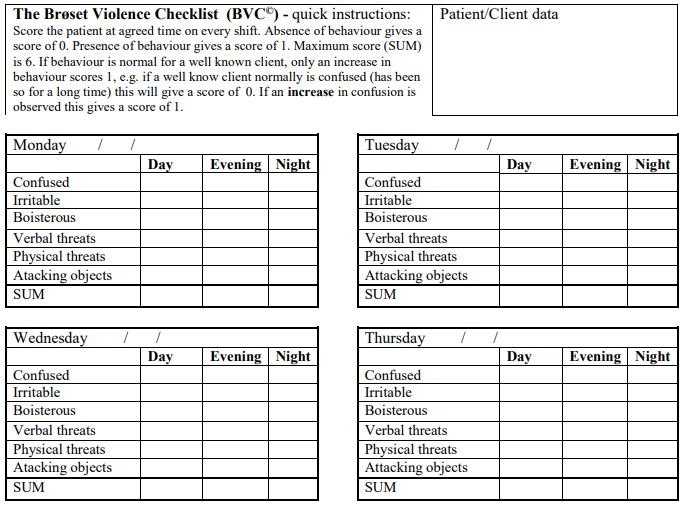
One of the main starting points for REWS was our experience of using the Brøset Violence Checklist (BVC). While the BVC is commonly used to predict short-term risk of violence, we wanted to develop a tool which helped us to change the way we managed the risk of violence by helping us to understand why patients were becoming more distressed and what we could do earlier to prevent this.
We wanted to move away from simply asking: “How likely is this patient to become violent?” and instead ask: “What is changing for this person, what might be causing it, and what can we do differently?”
REWS came from this idea (Figure 1). We wanted it to encourage a more relational, patient-centred and individualised approach. It looks at changes in areas including sleep and biological stress, relationships, emotional activation, sensory and environmental factors, engagement and early changes in behavior.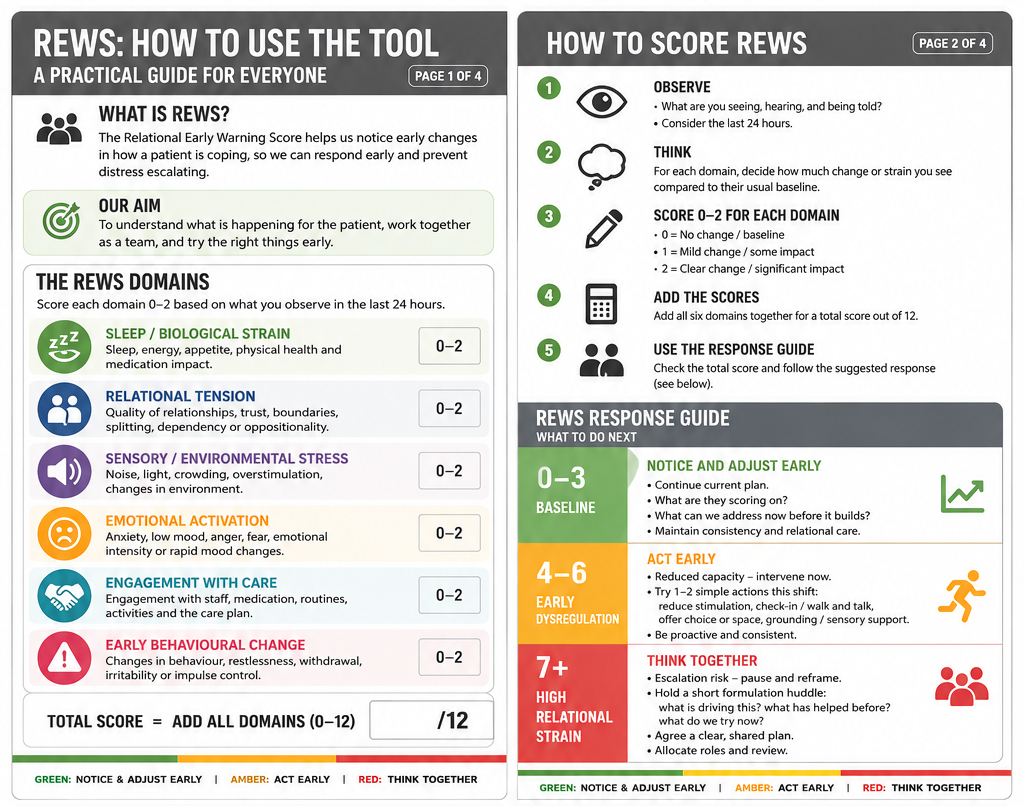 Figure 1. The REWS framework
From scoring to action
We introduced REWS on Rosebank on 28 April 2026 and built it into our existing daily MDT huddle.
The MDT discusses each patient and agrees a Green, Amber or Red rating. The rating itself is not really the important part. What matters is the discussion around it and the plan that comes from it.
The main question we ask is: “What are we going to do differently today?” (Figure 2)
That could mean looking at poor sleep, reducing stimulation on the ward, prioritising time with a staff member the patient has a good relationship with, reviewing medication or physical health, progressing leave, addressing difficulties with other patients, or involving family and carers. The score is really there to prompt the discussion. The important part is what we do with it.
When someone scores Red, this triggers a more detailed formulation huddle. The MDT comes together to think about what has changed, what might be driving the deterioration, what has helped before and whether there is anything about our approach or the ward environment that we need to change.
The aim is that a higher score does not automatically lead to more restriction. Instead, it should lead to more thought about what is happening and what we can do to help.
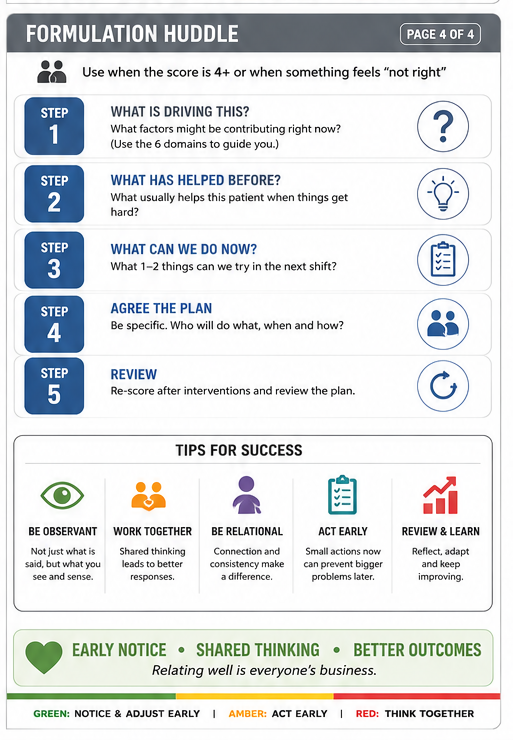 Figure 2. Formulation Huddle template. A Red REWS score triggers a formulation huddle and an individualised plan
What does the MDT think?
As you would expect with any new tool, there was some uncertainty when we first introduced REWS. Ward staff found some of the more relational domains harder to score, particularly relational tension and emotional activation.
We spent quite a bit of time discussing these domains and using examples from patients on the ward. We also realised that differences in scoring were not necessarily a problem. If two members of staff saw the same patient differently, that often led to a useful discussion about why. Someone may have noticed a change that others had missed, or the patient may have been relating very differently to different members of the team.
As the MDT became more familiar with REWS, the feedback became increasingly positive. Staff felt it gave them a clearer structure for discussing early changes in presentation and a shared language for things that can otherwise be difficult to describe.
We also collected structured feedback after the initial testing period (Figure 3). We asked staff about their confidence using REWS, whether it helped identify deterioration earlier, whether it improved MDT discussions and care planning, and whether they felt it could contribute to reducing violence and restrictive practices. 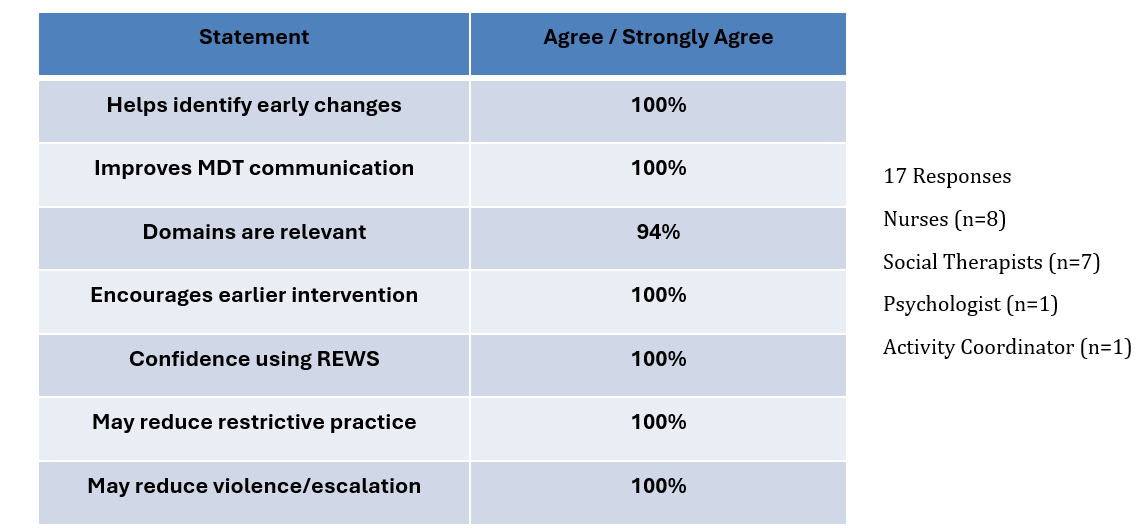 Figure 3. Staff feedback following the initial testing of REWS.
Is it making a difference?
Our experience so far has been positive, but we are careful about saying that REWS itself has reduced violence or restrictive practice. PICUs are complicated environments and incident levels can be affected by patient mix, acuity, staffing and many other factors.
We are looking at violence and aggression, restraint, rapid tranquillisation, use of enhanced observations and seclusion before and after introducing REWS. We also want to look beyond incident data and consider things such as how quickly patients are able to progress to leave and whether we are able to take positive risks earlier.
The next part of the project is looking more closely at how REWS is actually being used. Rather than just auditing whether a score has been completed, we are looking at the score, the plan that was agreed and, importantly, whether that plan was actually followed through.
More than a score
One of the main things we have learned is that REWS is most useful when we do not treat it as just another scoring tool. The number itself is probably the least interesting part. What matters is that it gives the MDT a chance to think together about some fairly simple questions:
- What has changed?
- What might be going on for this patient?
- What can we do differently today?
In Summary, we are not trying to get better at predicting violence. We are trying to notice changes earlier, understand what is happening and respond earlier, with care that is more relational and individualised.
Hopefully, by doing that well, we can also reduce aggression and the need for restrictive practices.
Most Read Stories
-
Why is Quality Control important?
18th July 2018
-
2016 QI Conference Poster Presentations
22nd March 2016
-
Recognising Racism: Using QI to Help Take Action
21st January 2021
-
-
QI Essentials: What does a Chief Quality Officer do?
18th March 2019

-
Using data enabled us to understand our problem
31st March 2023
Follow QI on social media
To keep up to date on the latest concerning QI at ELFT, follow us on our socials.