

The Story of Clissold Ward’s Journey to Reduce Unnecessary Intermittent Observations
24th October 2025
At Clissold Ward, part of the Low Secure Forensic Service, the team has been working on reducing the use of unnecessary intermittent observations. Staff and service users recognised that observations, while intended to manage risk, were sometimes being used for longer than needed and didn’t always feel helpful for the people being observed. The team wanted to find safer and more effective ways to support service users.
Understanding the Problem
The ward set up a Quality Improvement project as part of the Trust-wide Observation to Engagement programme. Two service users joined as representatives, and weekly QI meetings were held to plan and review progress.
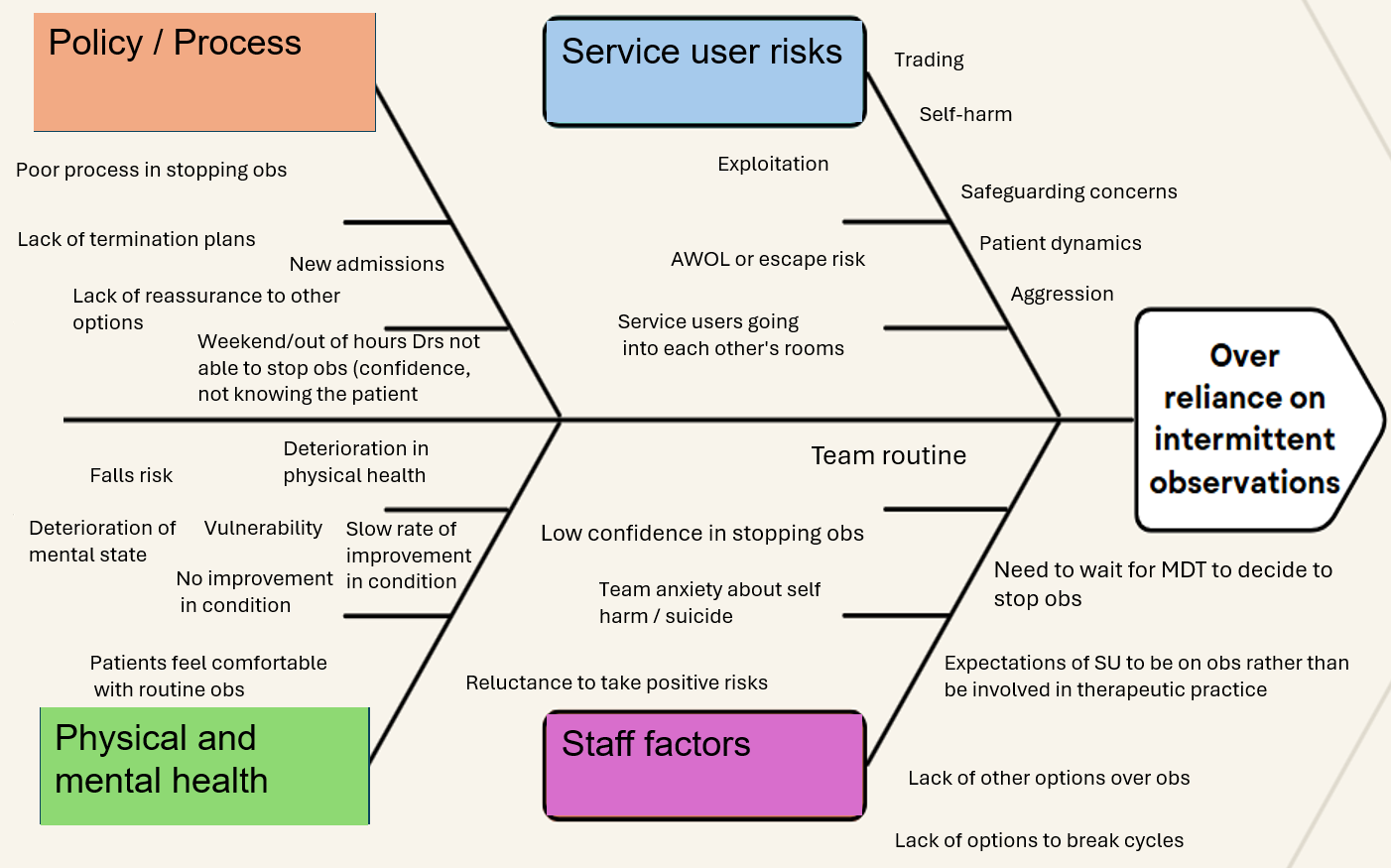
To understand the problem, the team created a fishbone diagram to explore the reasons behind the overuse of intermittent observations. They identified several contributing factors:
- Policy and process issues, such as unclear admission procedures and limited confidence in when to stop observations.
- Staff factors, including anxiety about risk and a lack of consistency in decision-making.
- Service user and environmental factors, such as limited engagement opportunities and challenges around ward activity levels.
This helped the team see that the issue wasn’t just about procedure – it was about confidence, culture, and communication.
Planning the Work
Using a driver diagram, the team agreed on their overall aim:
“To safely eliminate the use of inappropriate intermittent observations and introduce alternative approaches that actively engage staff, service users, and carers by March 2026.”
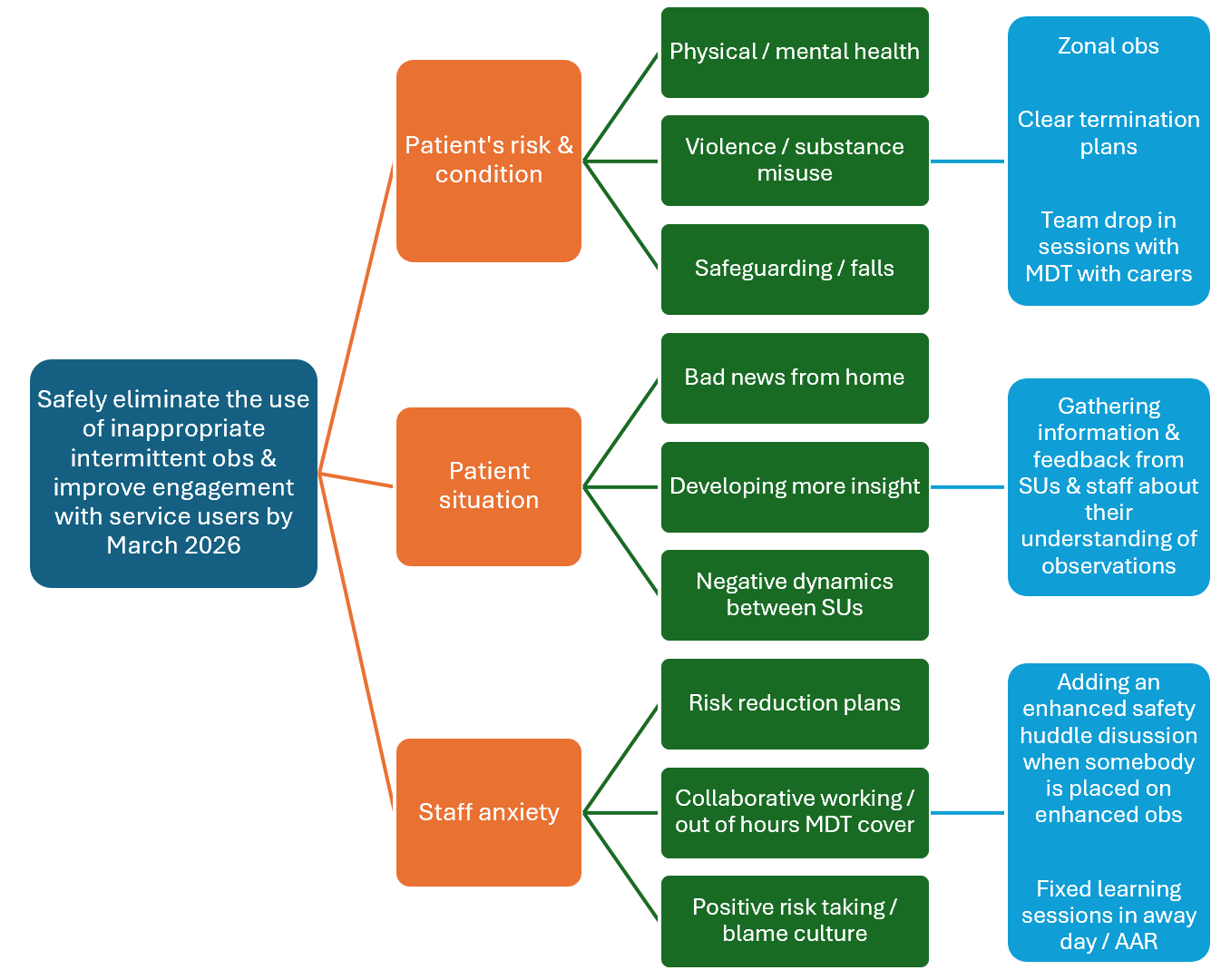
They identified key drivers for change – improving staff confidence, strengthening service user involvement, and ensuring consistent, collaborative decision-making. From this, they developed three initial change ideas:
- Zonal observations, where staff are allocated to areas of the ward rather than individual service users.
- Clear observation termination plans, agreed at the start of any observation period.
- Involving third sector organisations to deliver structured activities on the ward.
Testing and Learning
The team began by testing zonal observations, which replaced intermittent checks with more consistent staff presence in different areas of the ward. They are now refining this approach to make it work better in practice. This includes clearly mapping out each person’s role, identifying any additional support roles needed for staff working on the ward floor, and introducing a RAG rating system to monitor each service user’s level of risk. The idea is that by using the RAG system to spot early signs of deterioration, staff can intervene sooner and reduce the need for people to be placed on intermittent observations.
To support the zonal observation approach, the team are exploring ways to involve third sector and voluntary organisations in delivering ward activities. These activities are expected to help keep service users engaged and supported throughout the day, while also allowing nursing staff and the zonal observation nurse to focus on clinical priorities and other aspects of care.
The team are also testing having clear termination plans for observations, made in collaboration with the service user. It is hoped that this will reduce how long observations stay in place and provided clearer expectations for everyone involved. It will also be used to support discussions in safety huddles and multidisciplinary team meetings.
What is our data telling us
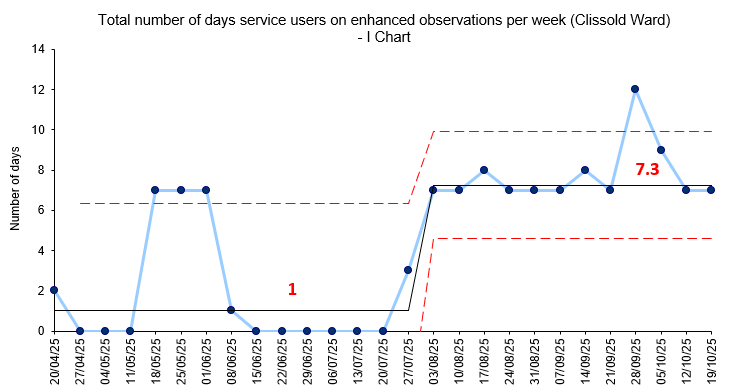
The chart below shows the total number of days that service users were on enhanced observations each week. In most weeks where observations were recorded, this was usually due to one service user being on continuous rather than intermittent observations. During the week of 29th August, a new service user was admitted to the ward and placed on intermittent observations. A clear plan was developed from the start to outline what needed to be achieved for these observations to be reduced and safely ended as soon as possible.
Next Steps
The team plan to continue collecting both qualitative and quantitative data to understand the ongoing impact of these changes. They will also receive the Art of Conversation training, delivered by experts by experience from the Recovery College, to help support the team’s change ideas and grow confidence in having everyday conversations with service users.
The project has already helped build stronger communication between staff and service users and encouraged a more thoughtful approach to how observations are used.
Most Read Stories
-
Why is Quality Control important?
18th July 2018
-
2016 QI Conference Poster Presentations
22nd March 2016
-
Recognising Racism: Using QI to Help Take Action
21st January 2021
-
-
QI Essentials: What does a Chief Quality Officer do?
18th March 2019
-
Using data enabled us to understand our problem
31st March 2023

Follow QI on social media
To keep up to date on the latest concerning QI at ELFT, follow us on our socials.